
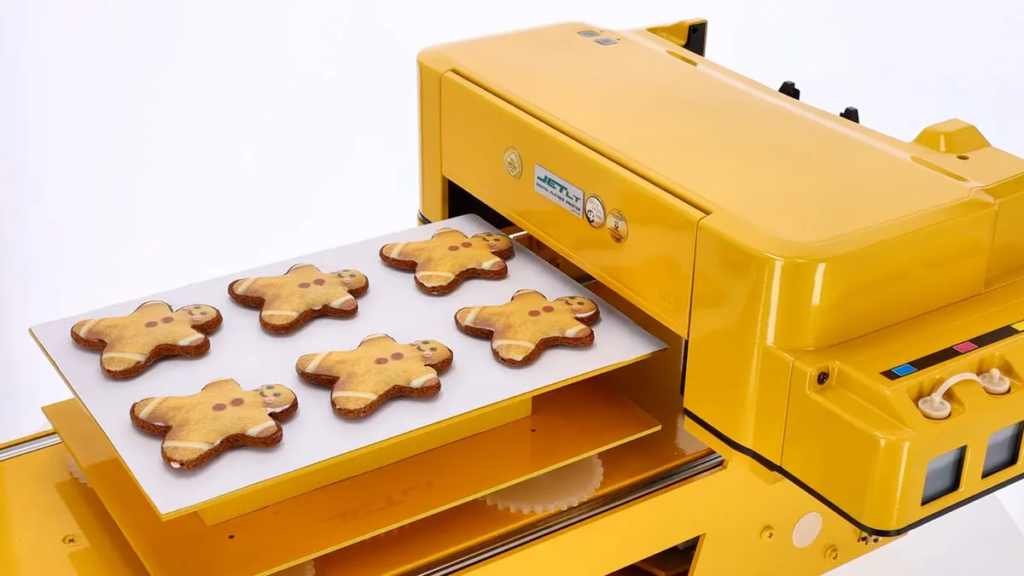
Walk into a family-run bakery in Vilnius, Krakow or Prague today, and you will notice something you would not have seen five years ago — photograph-quality images printed on cakes, cookies, and chocolate bars. The tools behind this shift are not artisanal skill or expensive automation. They are compact desktop food printers that print edible ink onto sugar sheets or wafer paper.
From decoration to differentiation
For small European bakeries, the challenge has always been the same: differentiation without inflating cost. Traditional freehand icing decoration takes a skilled cake decorator between 20 and 45 minutes. That cost is hard to recover on a single-cake order.
Edible printing collapses that decoration into a two-minute process. A cake decorator uploads a customer photo, prints it, and applies it to the cake surface. The unit cost of a printed edible sheet is under one euro, while the retail markup is often between fifteen and forty euros per cake.
What is driving the trend
Three market forces are pushing bakeries in Central and Eastern Europe toward this technology.
Personalized events. Weddings, corporate anniversaries and children’s birthdays all now expect customization. A cake with a couple’s wedding photo has become an emotional centerpiece, not a novelty.
B2B contracts. European corporate gifting is a growing segment — companies order 50 to 500 branded cookies or chocolate bars for employee events and client gifts. This kind of volume is difficult without automation. Bakeries that can print branded batches keep the contract.
Instagram and TikTok. Visual content drives repeat orders. A bakery that produces photogenic, personalized desserts earns organic marketing that traditional decorators cannot easily compete with.
The economics of small-scale bakeries
The math is straightforward. A mid-range food printer costs between 1,200 and 2,500 EUR. If a bakery sells one printed cake per day at a 20 EUR markup over unprinted equivalents, the printer pays for itself within four to six months. Higher-volume operations reach payback in six to ten weeks.
Consumables — edible inks, sugar sheets, wafer paper — cost around 0.30 to 0.90 EUR per printed image. Compared to the labor cost of hand-decoration, this is roughly a tenfold cost reduction per unit.
What buyers should look for
Not every food printer is built for continuous commercial use. Bakeries producing more than 30 units per day should look at devices designed for daily operation, with dedicated food-grade cartridges and consistent color calibration. Buyers can find comparison overviews and technical specifications at established European suppliers of edible printing technology.
The broader shift
Edible printing is not replacing traditional cake artistry — the best decorators still command a premium for hand-piped work. What it is replacing is the middle segment: standard birthday cakes, corporate cookies, and personalized bars that customers want fast and affordable. That segment is where European bakeries are quietly growing revenue.
Leave a Reply